Before you read this, I suggest you read post 25.3.
I briefly introduced the idea of a resonance hybrid in post 16.31. Since then, I’ve written a lot about resonance, especially in post 18.8. Unfortunately, understanding resonance won’t help you to understand resonance hybrids. Resonance is not involved in the concept of resonance hybrids. I don’t know where the name “resonance hybrid” came from but it is a possible source of confusion. Even worse, chemists sometimes talk about “resonance” to mean the existence of resonance hybrids and not the usual scientific meaning of the word! The term mesomerism was introduced for this non-standard use of “resonance” and resonance hybrids are sometimes called mesomers – but these terms are not widely used.
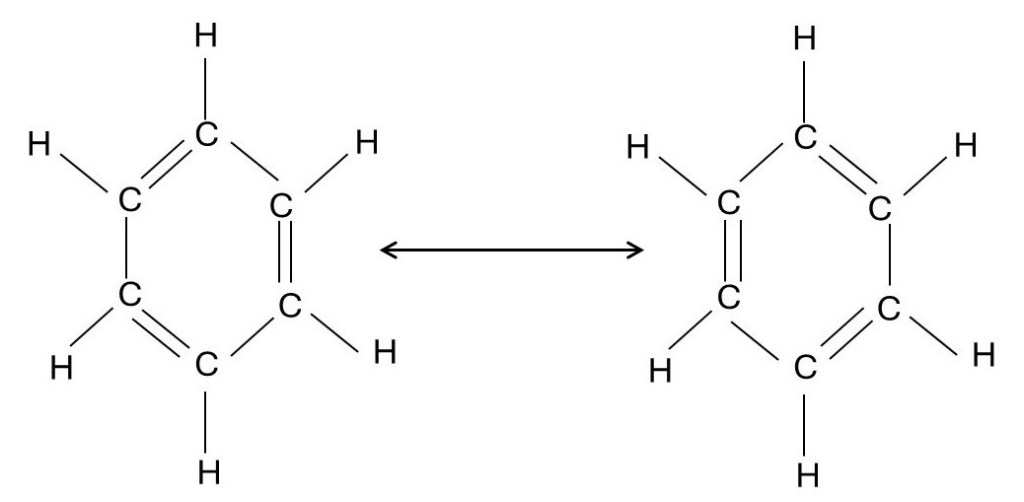
In post 25.3, we saw that neither of the formulae in the picture above truly represents the benzene molecule – the true pattern of shared electrons is intermediate between these two extremes. So benzene is really a hybrid of the two forms – in the same way that a mule is a hybrid between a horse and a donkey; This molecular hybrid is called a resonance hybrid. The double headed arrow is the conventional way of showing that the true structure is intermediate between these two forms. The two forms are called canonical forms. (So “canonical forms” are the same as “mesomers”.)
The true structure is more stable than either of the canonical forms would be. If we think of an electron as a standing wave, the more canonical forms are needed the longer the wavelength, λ, it can have because it is confined to a less restricted space, as explained in post 19.28. We can also think of the electron as a particle with momentum
p = h/λ (1)
according to post 19.24. A particle of mass m moving with a speed v has a momentum
p = mv
and a kinetic energy of
E = mv2/2 = (mv)2/2m = p2/2m. (2)
From equations 1 and 2,
E = h2/2mλ2.
So increasing the wavelength of an electron decreases its energy and so increases its stability. (See post 16.29 for details of the relationship between energy and stability of an electron.)
Be careful about the meaning of the previous paragraph! The canonical forms don’t really exist. They’re simply a way to help us to understand the distribution of electrons in the molecule. And the resonance hybrid is especially stable because we think of the molecule as having several canonical forms.
And be careful not to confuse the idea of resonance hybrids with isomers. Isomers really do exist and differ from each other in the position of their atoms. Resonance hybrids don’t really exist – they are an aid to understanding and they differ from each other in the positions of their electrons.
The formulae in the picture above differ only in the positions of their π bonds. Remember that a bond is a shared pair of electrons. So the canonical forms can be considered to be related to each other by movement of pairs of electrons. In the picture below, I use the convention of showing the movement of a pair of electrons by a curly arrow. The foot of the arrow shows where the electrons move from; the arrowhead shows where they move to.
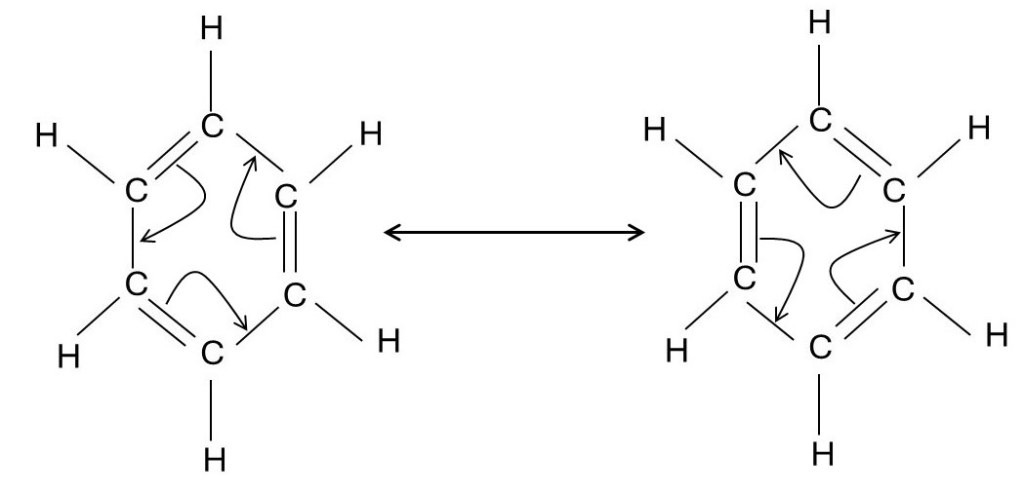
Again – be careful! Chemists use these curly arrows to show movements of pairs of electrons in chemical applications. Then the electrons really do move. But no movement occurs in the resonance hybrids because the two resonance hybrids of the benzene molecule don’t really exist: the true benzene molecule is intermediate between them.
So the concept of a resonance hybrid can be used to modify the valence bond theory to account for the properties of benzene.
Related posts
25.3 Benzene molecule
25.2 Sigma bonds and pi bonds
25.1 Hybrid orbitals
16.31 Electrons in molecules
16.30 Molecules
 Thinking about Science with David Hukins
Hi David
I spotted a small but crucial typo in this otherwise clear and helpful Blog.
I think equation (2) should read E= mv²/2 without the bracket or (mv)²/2m with it.
Its great having this reminder of material I first learned decades ago which has since laid fallow. I appreciate the brevity and focus of each blog.
Andrew Morris
LikeLike
Thank you Andrew. I will correct this.
LikeLike