Before you read this, I suggest you read posts 16.30 and 24.12.
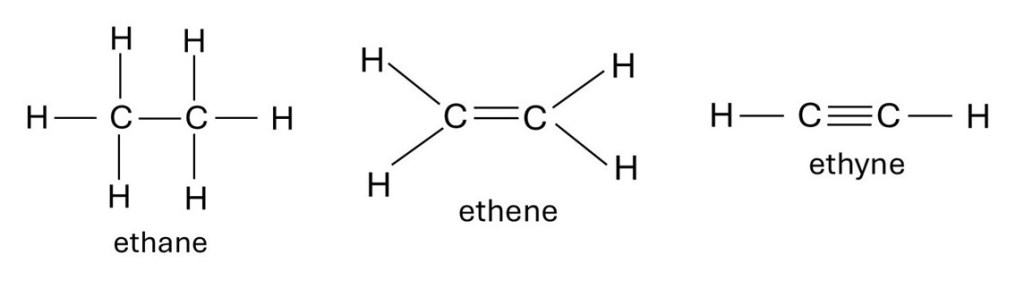
I am going to use the bonding in molecules of ethane, ethene and ethyne (see the picture above) to introduce the concept of hybrid orbitals. In post 16.31, we saw that, according to the valence bond theory, a molecule consists of atoms held together by chemical bonds; each bond is two electrons shared between two atoms in the molecule. The molecules I have chosen consist of two carbon atoms joined by a single bond (ethane), a double bond (ethene) or a triple bond (ethyne). Each carbon atom forms four bonds; in the four molecules the bonds that aren’t between carbon atoms are between carbon and hydrogen atoms, as shown in the picture above.
In post 24.12 we saw that the carbon atom has six electrons. Two of these electrons are in the low energy 1s orbital; because they are already paired with opposite electron spins (see post 24.12) they do not need to form bonds with other atoms (see post 16.30). The remaining four electrons are in 2s and the three 2p orbitals and we can represent the occupancy of electron energy levels in as 1s2, 2s2, 2px1, 2py1 (see post 24.12). If energy is provided to move an electron from 2s to 2pz, the occupancy becomes 1s2, 2s1, 2px1, 2py1, 2pz1 and there are four unpaired electrons to form bonds as described in post 16.30.
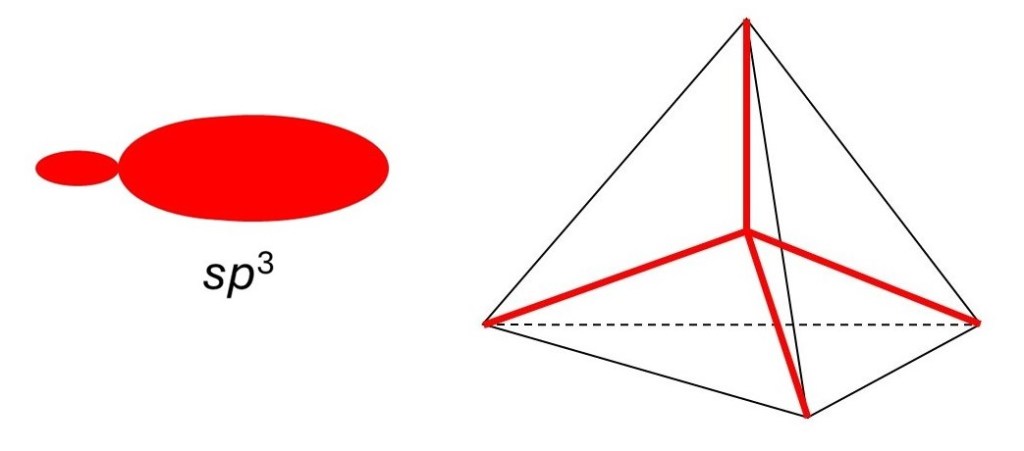
But in post 16.30 we saw that the four equivalent bonds in a molecule like methane, and similarly in ethane, point towards the corners of a tetrahedron because their electron pairs repel each other in a three-dimensional space. How can we reconcile this observation with the electrons in a carbon atom being in p orbitals that are mutually perpendicular (pointing along the axes of an orthogonal Cartesian coordinate system) and an s orbital that has no preferred direction? To answer this question, remember that the atomic orbitals are derived from wave functions that are solutions of Schrödinger’s equation – a partial differential equation. Remember also that any linear combination of solutions to a differential equation is also a solution (see post 19.10). So to explain the formation of four equivalent bonds in a molecule like methane we need to take a linear combination of the wave functions for the s, px, py and pz orbitals to form four equivalent orbitals that point towards the corners of a tetrahedron. These four orbitals are called hybrid orbitals – because they are hybrids of the atomic orbitals used to describe the probabilistic positions of electrons in a free atom (see post 24.12). They are called sp3 orbitals and, because there are four of them that are equivalent in a three-dimensional space, they point towards the corners of a tetrahedron. Each sp3 orbital has a quarter of the character of an s orbital and three-quarters the character of a p orbital; one is shown in the picture below (left-hand side). The four sp3 orbitals are cylindrically symmetric about the red lines in the picture below (right-hand side). The angle between these red lines is about 109.5o (see appendix 1). More details on the formation of sp3 hybrid orbitals is given in appendix 2.
The carbon atoms in ethene form bonds in three directions; each forms two single bonds with a hydrogen atom and a double bond with another carbon atom. So each carbon atom forms bonds in three directions. Since the electron pairs in these bonds repel each other, the three directions make an angle of 120o with each other and define a plane; a brief explanation is given in post 16.47. Now let’s pursue this idea a bit further.
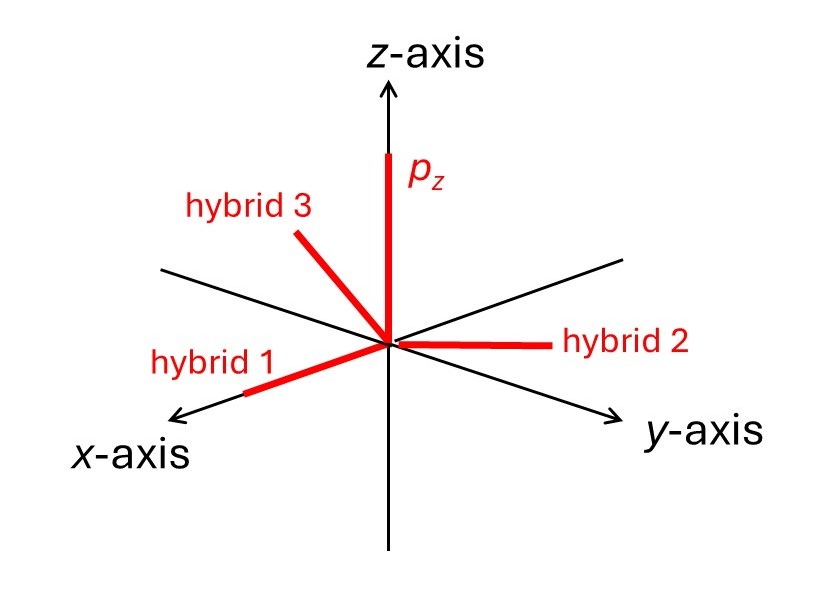
To form three equivalent bonds, we’ll start with a carbon atom with the electron configuration 1s2, 2s1, 2px1, 2py1, 2pz1, as we did before. But now we’ll take a linear combination of one s orbital and two p orbitals to form three equivalent sp2 orbitals, each with one-third the character of an s orbital and two-thirds the character of a p orbital. So an sp2 orbital is very similar to an sp3 orbital but a bit less elongated. Let’s take the px and py orbitals to make these hybrids, so that the electron configuration of our carbon atom can now be represented as 1s2, 2(sp21)1 2(sp22)1, 2(sp23)1, 2pz1, where sp21, sp22 and sp23 represent three sp2 hybrid orbitals that form an angle of 120o with each other and the superscript 1 denotes the number of electrons in each orbital. The picture below shows the axes of the three hybrid orbitals (in red) lying in a plane (the xy plane) and making an angle of 120o with each other and the pz orbital perpendicular to the plane (in the z-direction); so the axes of the hybrid orbitals point towards the corners of an equilateral triangle. Since the three hybrid orbitals and the remaining p orbital contain a single, unpaired electron they can form chemical bonds. We will consider these bonds in more detail in the next post. More details on the formation of sp2 hybrid orbitals are given in appendix 5.
The carbon atoms in ethyne form bonds in two directions; each forms a single bond with a hydrogen atom and a triple bond with another carbon atom. So each carbon atom forms bonds in two directions. Since the electron pairs in these bonds repel each other, the two directions make an angle of 180o with each other and lie in a straight line. Now let’s think about forming the corresponding hybrid orbitals.
To form two equivalent bonds, we’ll start with a carbon atom with the electron configuration 1s2, 2s1, 2px1, 2py1, 2pz1, as we did before. Now we’ll take a linear combination of one s orbital and one p orbital to form two equivalent sp orbitals, each with half the character of an s orbital and half the character of a p orbital. So an sp orbital is very similar to an sp2 orbital but is less elongated. Let’s use the px orbital and the s orbital to make the two sp hybrids, so that the py and pz are not involved in hybrid orbital formation. The electron configuration of our carbon atom can now be represented as 1s2, 2(sp1)1 2(sp2)1, 2py1, 2pz1, where sp1 and sp2 represent two sp hybrid orbitals that lie in a straight line (in the positive and negative x-directions). As before, the superscript 1 denotes the number of electrons in each orbital. Since the two hybrid orbitals and the two remaining p orbitals contain a single, unpaired electron they can form chemical bonds. In the next post, we shall see that the four atoms in an ethyne molecule then lie in a straight line. More details on the formation of sp hybrid orbitals are given in appendix 6.
Related posts
24.12 Atomic orbitals
16.31 Electrons in molecules
16.30 Molecules
16.29 Electrons in atoms
Appendix 1 The tetrahedral angle
The purpose of this appendix is to show that the angle between the red lines that join the centre of a regular tetrahedron to its corners (second picture in this post) is about 109.5o.
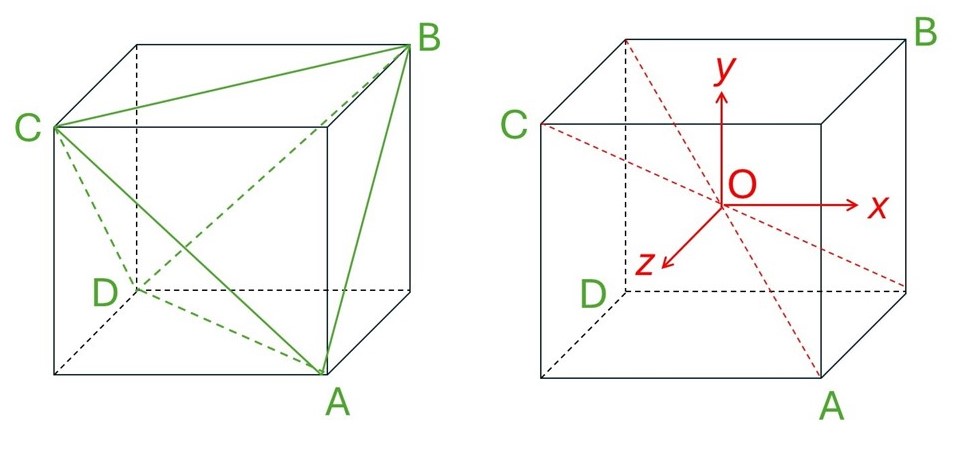
The picture above (left-hand side) shows the sides of a regular tetrahedron (shown in green) can be drawn by joining the corners A, B, D and C of a cube. The centre of the cube and, therefore, the centre of the tetrahedron, is at O in the picture above (right-hand side). I am going to define O as the origin of an orthogonal Cartesian coordinate system. The directions of the x, y and z-axes are defined by the sides of the cube and form a right-handed set as shown. If the cube has a side of length 2 units, the coordinate of A and B are (1, -1, 1) and (1, 1, -1), respectively. Then the vectors defining the positions of A and B are
a = i – j + k and b = i + j + k
(see post 17.3). The angle, θ, between these vectors can be calculated from their dot product defined as
a.b = abcosθ.
Calculating this dot product from a and b gives
a.b = 1 – 1 – 1 = -1.
The modulus of a and of b can be calculated from the dot products
a.a = 3 and b.b = 3 so that a2 = 3 and b2 = 3.
Then a = √3 and b = √3.
Substituting these values for a.b, a and b into the definition of the dot product gives the result that
cosθ = -1/3.
Using a calculator, arccos(-0.3333) is 109.47o so that θ = 109.47o.
Appendix 2. Wave functions for sp3 hybrid orbitals
The wavefunctions for the four sp3 orbitals (ϕ1, ϕ2, ϕ3, ϕ4) are formed by linear combinations of the wavefunctions ψs (for the s orbital), ψx (for the px orbital), ψy (for the py orbital) and ψz (for the pz orbital), so that
ϕ1 = a1ψs + b1ψx + c1ψy + d1ψz 1a
ϕ2 = a2ψs + b2ψx + c2ψy + d2ψz 1b
ϕ3 = a3ψs + b3ψx + c3ψy + d3ψz 1c
ϕ4 = a4ψs + b4ψx + c4ψy + d4ψz 1d
where a, b, c and d denote unknown coefficients whose values we need to determine.
Let’s start with the a coefficients. Since the s orbital is a sphere, it must contribute equally to all four hybrid orbitals. Since ψs will be normalised (that is it will have been subjected to normalisation), after solving Schrödinger’s equation , ψs2 = 1. Then (a1ψs)2 makes a quarter of the contribution to ϕ12 so that (a1ψs)2 = ϕ12/4. We want the wavefunctions for our hybrid orbitals to be normalised too, so that, for example, ϕ12 = 1. Then a12 = 1/4 or a1 = 1/2 . We can apply the same argument to all four hybrid orbitals with the result that
a1 = a2 = a3 = a4 = 1/2 2
We can now start to determine the values of the other coefficients. We want the four hybrid orbitals to be independent of each other and not interact so they must be orthogonal (like the coordinates of a point in an orthogonal coordinate system) with the results that
anam + bnbm + cmcn + dmdn = 0 3
where n = 1, 2, 3, 4 and m = 1, 2, 3, 4 and n ≠ m. For more explanation, see appendix 3. And we want to ensure normalisation of their wavefunctions so that
an2 + bn2 + cn2 + dn2 = 1 4
as explained in appendix 4.
2.1 Coefficients in equation 1a
Now we are going to let the axis of ϕ1 define the z-axis direction. Then b1 = c1 = 0 with the result that equation 1a becomes
ϕ1 = a1ψs + d1ψz = (1/2)ψs + d1ψz 5
where the final step comes from equation 2.
From equation 4
1 = a12 + b12 + c12 + d12 =1/4 + 0 + 0 + d12.
Then
d1 = √3/2
So that equation 5 becomes
ϕ1 = (1/2)ψs + (√3/2)ψz 6
2.2 Coefficients in equation 1b
Now we are going to let the axis of ϕ2 define the x-axis direction so that c2 = 0 and equation 1b becomes
ϕ2 = (1/2)ψs + b2ψx + d2ψz 7
noting the value for a2 from equation 2. From equation 3
a1a2 + b1b2 + c1c2 + d1d2 = 0.
Since b1 = c1 = 0 and substituting the results for d1 from sub-section 2.1 gives
(1/2)(1/2) + 0 + 0 +(√3/2)d2 = 0
so that
d2 = -1/(2√3).
From equation 4
a22 + b22 + c22 + d22 = 1.
Substituting the values of the coefficients already obtained gives
(1/2)2 + b22 + 0 + {-1/(2√3)}2 = 1/4 + b22 + 1/12 = 0
so that
b2 = √2/√3.
Now equation 7 becomes
ϕ2 = (1/2)ψs + (√2/√3)ψx – (1/2√3)ψz 8
2.3 Coefficients in equation 1c
Noting, from equation 3, that
a2a3 + b2b3 + c2c3 + d2d3 = 0
and the values of a2 and c2 in sub-section 2.2, gives
(1/2)a3 + (√2/√3)b3 + 0 + d2d3 = 0.
Remember that equation 2 establishes a value for a3 so that this result becomes
(1/2)(1/2) + (√2/√3)b3 + 0 + d2d3 = 0. (9)
Now we need to think geometrically. Think about a regular tetrahedron resting on one of its triangular faces as base. The origin of our hybrid orbitals is at the centre of this tetrahedron and their lobes point towards its corners. In sub-section 2.1, we defined ϕ1 to point upwards in the positive z-direction. Then the lobes for ϕ2, ϕ3 and ϕ4 must point in the negative z-direction by the same distance as each other so that
d4 = d3 = d2 = -1/(2√3).
Now equation 9 becomes
(1/2)(1/2) + (√2/√3)b3 + 0 + (1/2√3)(1/2√3) = 0
with the result that
b3 = -1/√6.
From equation 4 (the normalisation condition)
a32 + b32 + c32 + d32 = 1
so that
(1/2)2 + (1/√6)2 + c32 + (1/2√3)2 = 1 or c3 = 1/√2.
Putting all the results from this sub-section into equation 1c gives
ϕ3 = (1/2)ψs – (1/√6)ψx + (1/√2)ψy – (1/2√3)ψz. (10)
2.4 Coefficients in equation 1d
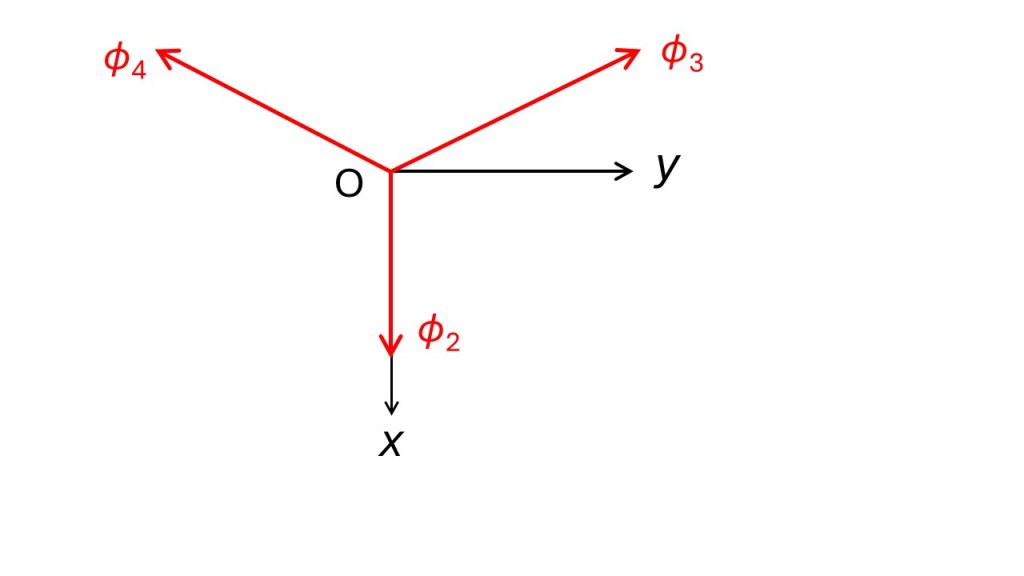
The picture above is a projection on to the xy-plane. The lobe of ϕ1 points upwards, towards you, in the z-direction. The lobe of ϕ2 lies in the xz plane and points away from you below the plane of the picture. I have defined the directions of the lobes of ϕ2, ϕ3, and ϕ4 as the 2, 3 and 4 directions respectively. The angle between directions 2 and 3 is the same as that between 3 and 4 and between 4 and 2, because they are in the directions of the corners of a regular tetrahedron. For this to be true b4 = b3 (same coefficient for ψx) and c4 = –c3 (negate the coefficient for ψy). Otherwise the coefficients for are the same as in equation 10, so that equation 1d becomes
ϕ4 = (1/2)ψs – (1/√6)ψx – (1/√2)ψy – (1/2√3)ψz. (11)
2.5 Angle between ϕ1 and ϕ2
I have chosen ϕ1 and ϕ2 as an example to show that the angle between the axes of sp3 hybrid orbitals is the tetrahedral angle of appendix 1.
I am going to represent the wavefunctions by vectors, as explained in appendix 3. From equation 6
ϕ1 = (1/2)ψs + (√3/2)ψz
so that
r1 = (√3/2)k
and its modulus
r1 = (√3/2).
In representing ϕ1 by r1, we note that there is no specific direction associated with ψs.
From equation 8
ϕ2 = (1/2)ψs + (√2/√3)ψx – (1/2√3)ψz
so that
r2 = (√2/√3)i – (1/2√3)k
and
r22 = (√2/√3)2 + (-1/2√3)2 or r2 = √3/2.
Calculating the dot product of r1 and r2 gives
r1.r2 = (√3/2)(-1/2√3) = -1/4.
From the definition of the dot product
r1.r2 = r1r2cosθ = (√3/2)(√3/2)cosθ = (3/4)cosθ.
Comparing these results gives
(3/4)cosθ = -1/4 or cosθ = -1/3
which is the tetrahedral angle of appendix 1.
Appendix 3 Orthogonality
In this appendix, I’m going to use the representation of a wave by a vector to explain equation 3.
In the picture above, the point P rotates about O, the origin of a two-dimensional orthogonal Cartesian coordinate system, with an angular speed ω so that, after time t, OP makes an angle ωt with the x-axis.
We can represent the position of P by the vector
r = ixcosωt + jrsinωt,
where i and j are unit vectors defining the x and y-axis directions.
We can also represent the position of P by the complex number
ψ = reiωt
where r is the length of OP and i is the square root of -1. In post 18.11, we saw that the second representation can also be used to represent a wave of amplitude r and angular frequency ω.
So we can also use a vector to represent a wave.
Now let’s think about two three-dimensional vectors r1 and r2 defined by
r1 = a1i + b1j + c1k and r2 = a2i + b2j + c2k.
We can represent the dot product of the two vectors by
r1. r2 = a1a2 + b1b2 + c1c2
and could continue this property of the dot product into four or more dimensions.
We can also represent the dot product as
r1. r2 = r1r2cosθ.
If r1 and r2 are orthogonal, that is they are independent of each other, then θ = 90o so that r1. r2 = 0. Then we can express the condition for orthogonality of r1 and r2 as
a1a2 + b1b2 + c1c2 = 0.
Applying this idea to our hybrid orbitals gives equation 3.
Appendix 4 Normalisation
In this appendix, I’m going to use the representation of a wave by a vector to explain equation 4.
In our vector representation, normalisation is ensuring that rn. rn = 1, so that
an2 + bn2 + cn2 = 1.
For our hybrid orbitals we can extend this result to give equation 4.
Appendix 5. Wave functions for sp2 hybrid orbitals
The wavefunctions for the three sp2 orbitals (ϕ1, ϕ2, ϕ3) are formed by linear combinations of the wavefunctions ψs (for the s orbital), ψx (for the px orbital) and ψy (for the py orbital), so that
ϕ1 = a1ψs + b1ψx + c1ψy 12a
ϕ2 = a2ψs + b2ψx + c2ψy 12b
ϕ3 = a3ψs + b3ψx + c3ψy 12c
where a, b, and c denote unknown coefficients whose values we need to determine.
Since the s orbital is a sphere, it must contribute equally to all three hybrid orbitals. Since ψs will be normalised, after solving Schrödinger’s equation (see post 19.28), ψs2 = 1. Then (a1ψs)2 makes a third of the contribution to ϕ12 so that (a1ψs)2 = ϕ12/3. We want the wavefunctions for our hybrid orbitals to be normalised too, so that, for example, ϕ12 = 1. Then a12 = 1/3 or a1 = 1/√3 . We can apply the same argument to all three hybrid orbitals with the result that
a1 = a2 = a3 = 1/√3. 13
Let the x-axis define the axis of ϕ1 then c1 = 0.
The condition for normalisation (appendix 4) is that
a12 + b12 + c12 = 1.
Substituting values for a1 and c1 into this condition gives
(1/√3)2 + b12 + 0 = 1 so that b1 = √(2/3). 14
The condition for orthogonality of our hybrid orbitals (appendix 3) is that
a1a2 + b1b2 + c1c2 = 0
and, since c1 = 0,
a1a2 + b1b2 = 0. 15
Similarly
a1a3 + b1b3 = 0. 16
From equations 13, 14 and 15
(1/√3)(1/√3) + (√2/√3)b2 = 0
so that
b2 = -1/(√3.√2) = -1/√6. 17
Again using the condition for normality gives
a22 + b22 + c22 = 1.
Substituting from equations 13 and 17, for values of a2 and b2, into this result gives
(1/√3)2 + (-1/√6)2 + c22 = 1 or c22 = 1/2 or c2 = ±1/√2. 18
In the same way, from equations 13, 14 and 16 (instead of 13, 14 and 15) we could get the results that
b3 = = -1/√6 and c3 = ±1/√2.
It might look as if a2 = a3, b2 = b3 and c2 = c3 which would make equations 12b and 12c identical. This makes no sense if we want to describe three different sp2 orbitals. We can resolve this problem by choosing the positive square root for c2, from equation 18, and the negative square root for c3. Then equation 12 becomes
ϕ1 = (1/√3)ψs + (√2/√3)ψx 19a
ϕ2 = (1/√3)ψs – (1/√6)ψx + (1/√2)ψy 19b
ϕ3 = (1/√3)ψs – (1/√6)ψx – (1/√2)ψy 19c
I am going to use equations 19a and 19b to show that the angle between the axes of sp2 hybrid orbitals is 120o.
Representing the wavefunctions by vectors (appendix 3) gives
r1 = (√2/√3)i modulus r1 = (√2/√3)
r2 = -(1/√6)i + (1/√2)j = -(1/√2)(1/√3)i + (1/√2)j
so that its modulus is given by
r22 = (1/6) + (1/2) = 2/3 or r2 = √2/√3.
Calculating the do product of r1 and r2 gives
r1. r2 = -(√2/√3).(1/√2)(1/√3) = -1/3.
From the definition of the dot product
r1. r2 = r1r2cosθ = (√2/√3)(√2/√3)cosθ = (2/3)cosθ.
where θ is the angle between the vectors. Comparing these results gives
cosθ = -1/2.
Using a calculator (arccos function) gives θ = 120o.
(Alternatively, bisect an equilateral triangle to give two right-angled triangles and use the result to calculate cos60o then use the expression for the cosine of the sum of angles, in the appendix to post 19.13, to find cos120o).
Appendix 6. Wave functions for sp hybrid orbitals
The wavefunctions for the two sp orbitals (ϕ1, ϕ2,) are formed by linear combinations of the wavefunctions ψs (for the s orbital) and ψx so that
ϕ1 = a1ψs + b1ψx 20a
ϕ2 = a2ψs + b2ψx 20b
where a and b denote unknown coefficients whose values we need to determine.
Since the s orbital is a sphere, it must contribute equally to both hybrid orbitals. Since ψs will be normalised, after solving Schrödinger’s equation (see post 19.28), ψs2 = 1. Then (a1ψs)2 makes a half of the contribution to ϕ12 so that (a1ψs)2 = ϕ12/2. We want the wavefunctions for our hybrid orbitals to be normalised too, so that, for example, ϕ12 = 1. Then a12 = 1/2 or a1 = 1/√2 . We can apply the same argument to ϕ2 with the result that
a1 = a2 = 1/√2.
The condition for normalisation (appendix 4) is that
a12 + b12 = 1 so that (1/2) + b12 = 1 or b1 = ±√(1/2).
The same argument would give an identical value for b2. Using the positive square root for ϕ1 and the negative square root for ϕ2 gives, from equation 20, the wavefunctions become
ϕ1 = (1/√2)ψs + (1/√2)ψx 21a
ϕ2 = (1/√2)ψs – (1/√2)ψx 21b
Since the axes of ϕ1 and ϕ2 point along the positive and negative x-axis directions, respectively, the angle between them is 180o.
 Thinking about Science with David Hukins
How amazing – I was searching for something on DNA-ligand binding for a science blog I write, and I came across a reference to Struther Arnott and then to you. I remember so vividly six weeks in the summer of 1969 when, as an undergraduate in physics at UCL, I had the fortune to get a vacation placement with you and Struther. You taught me a lot – especially about computing in htose ealry days -and inspired me. I went on to do a PhD in Molecular Biophysics at Leeds. I didn’t stay in research but went into teaching and education research. In retirement I continue to run science discussion groups for interested adults. Thanks for being an early role model in my formative years! Andrew Morris a.j.morris@ucl.ac.uk
LikeLike
Thank you – I’m pleased that your vacation placement at King’s College proved useful!
LikeLike