Before you read this, I suggest you read post 26.8.
Length contraction is the idea that the concept of length changes when an object moves with a speed comparable with the speed of light. It is not about thermal contraction – the decrease in the length of an object when its temperature decreases.
In post 26.8 we saw how motion at speeds comparable to the speed of light influences the concept of time: here we will investigate how it influences the concept of length. The two posts could be considered as a complication in our understanding of length and time as given in post 16.12. They are another example of how explaining science involves diminishing deception – see post 17.25.
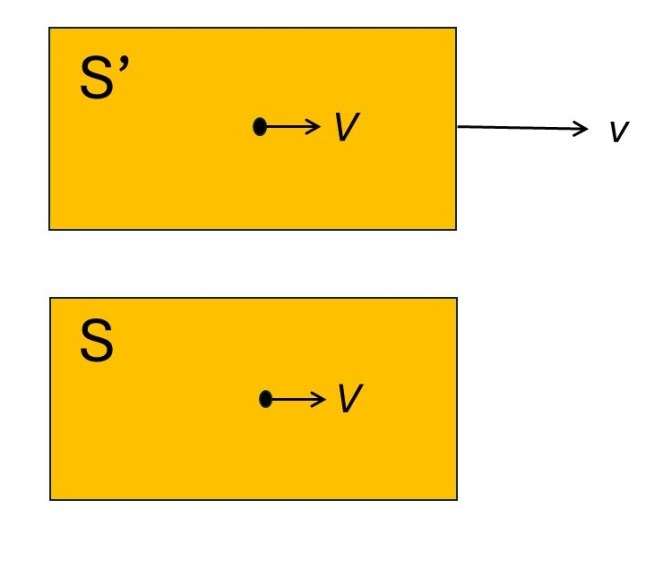
Let’s think about two inertial frames of reference S and S’; S’ moves with a speed v relative to S. The velocity of S’, relative to S, is given by the vector v. I am going to use the direction of v to define direction in the rest of this post.
Now let’s think about an object in S’ that moves with a speed V, in the direction of v. An observer in S’ measures the distance, L’, that it travels in time t, so that

Another object moves with speed V, also in the direction of v, but in the frame of reference S. An observer in S attempts to repeat the measurement of the movement of this object. In this frame of reference, the time that elapsed when the measurement was made in S’ is t’. (Because it is a time, t, in S’ viewed in the frame of reference S – see posts 26.8 and 26.9). The distance travelled in S is given by

From equations 1 and 2

But, in post 26.8, we saw that

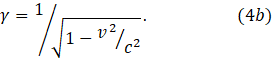
where γ is given by
From equations 3 and 4 we get that

Equation 5 tells us that the concept of length depends on the state of motion of an object but that this effect is negligible unless its speed is comparable to the speed of light. Lengths are shorter when objects are in motion, at speeds that are not much less than c, because v2 must be less than c2 if the value of L’ is a real number.
Related posts
26.9 The twin paradox
26.8 Time dilation
26.7 Einstein’s special theory of relativity
16.12 Measuring movement
16.4 Movement

