Before you read this, I suggest you read post 26.8.
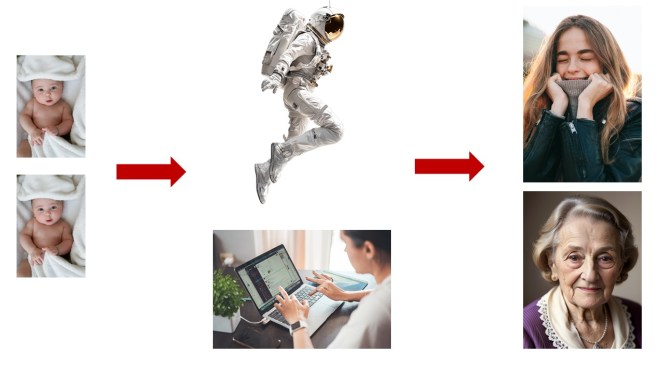
We’re going to think about hypothetical twins. When they become adults, one works in a bank: the other becomes an astronaut. The astronaut goes on a very long journey often at speeds comparable to the speed of light. During this time, the banker twin becomes old and retires from work. Then the astronaut returns home but is much younger than the retired banker. So we have twins who are very different ages! How can this be possible?
The previous paragraph describes the twin paradox. It is really a thought experiment based on Einstein’s special theory of relativity.
I have two criticisms of the way in which the twin paradox is often presented.
One: it is not very important – it’s simply a consequence of time dilation.
Two: its name is misleading.
So why am I writing a blog post about it? The twin paradox is often presented, without much explanation, to create the idea that physics is mysterious or weird. I want to show that it follows logically from Einstein’s special theory of relativity that is itself a logical interpretation of the relationship between Maxwell’s equations and the speed of light (post 26.6).
In the first paragraph, the astronaut travels at speeds comparable to the speed of light with respect to the banker twin. So time passes more slowly for the astronaut than for the banker – as explained in post 26.8. (You may find the appendix useful too.) Therefore, the astronaut ages slower than the banker. Einstein was aware of this consequence of his theory. But it was the German mathematician and physicist Hermann Weyl who first described it in terms of twins aging at different rates.
The twin paradox has sometimes been used to question the validity of Einstein’s theory – basically because it is obvious that twins must be the same age. In post 17.1, I show that science sometimes leads to conclusions that are the opposite of what appears obvious. The twin paradox provides another example.
Why do I think the name of the twin paradox is misleading?
The reason is that, in logic, a paradox is usually considered to be a statement that contradicts itself – like the statement (highlighted in yellow) below.

If this statement is true, it must be false. If it is false, it must be true.
The twin paradox does not present a problem of this kind. It is a logical consequence of relative motion affecting time.
In everyday English, the word “paradox” is sometimes used to mean the surprising result of a logical argument. But who is surprised? If you have read post 26.8, the twin paradox shouldn’t surprise you. If you believe that, under any circumstances (real or imaginary), twins must be the same age then the twin paradox is surprising. In other words, whether or not it is surprising is completely subjective. In post 16.36, I argue that science tries to avoid being subjective, so that this use of “paradox” is not consistent with the way science works.
However we use the word “paradox”, it is not a good description of the thought experiment in the first paragraph. And the first paragraph describes a logical conclusion from Einstein’s special theory of relativity.
Related posts
26.8 Time dilation
26.7 Einstein’s special theory of relativity

