Before you read this, I suggest you read posts 16.12 and 26.7.
I introduced the concept of time in post 16.12. However, the special theory of relativity leads to an unexpected property of time – it depends on the state of motion of an observer; time does not pass equally in different inertial frames of reference. The more quickly you move, the slower time passes. (But see the comment on this post from Andrew Morris. After reading this comment I wrote the appendix. I hope that, once you’ve followed the derivations below, that this appendix will make the interpretation of the equations easier.) We don’t normally notice this effect because it only becomes appreciable at speeds that are comparable to the speed of light in a vacuum, c. This effect is called time dilation.
Is there an experimental test of time dilation? Yes. In 1940, the American physicists Bruno B Rossi (1905-1993) and David B Hall (I can’t find anything more about him) measured the rate of decay of a subatomic particle called the muon. They found that muons decayed more slowly when travelling at a speed close to c.
What is the explanation of time dilation?
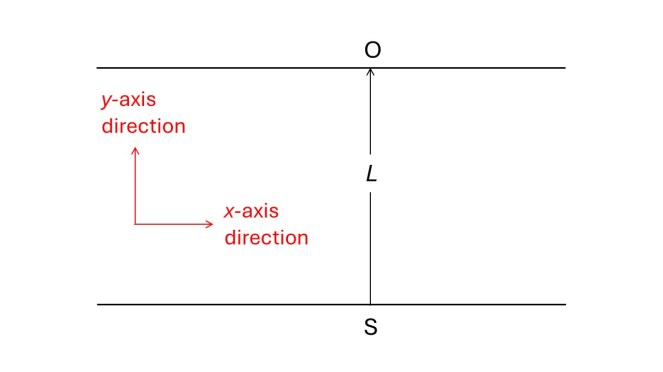
The picture above shows a section through two parallel planes that appear as lines containing the points S and O. I will define an orthogonal Cartesian coordinate system, with its origin at S, whose x-axis lies along the lower line. O is vertically above S, so that SO defines the y-axis. The length of SO is L. The two planes do not move with respect to each other. If a burst of light takes time, t, to travel from S to O then, from the definition of speed

We will now suppose that O is the position of an observer.
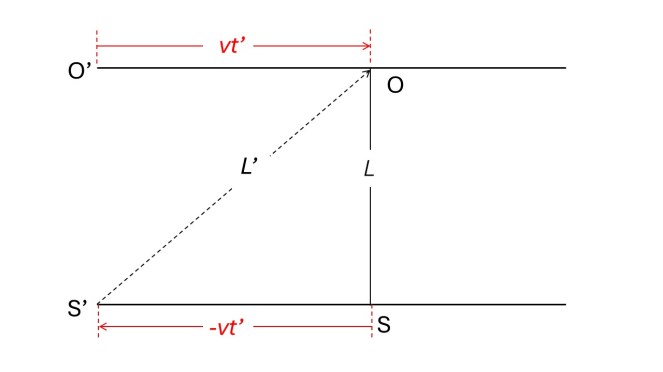
Now let’s suppose that the upper plane moves at a speed v, relative to S, in the x-axis direction, as shown in the picture above. When the burst of light leaves S, O is at O’, a distance –vt’ from O, where t’ is the time the burst of light takes to reach O. Why have I now defined this time to be t’ and not t? Because things are in motion and I can’t be sure of the effects of this motion.
Now let’s think of the motion relative to the observer. The observer is now considered to be stationary (see post 16.12) so that S is considered to be moving in the minus x-axis direction. When the light reaches the observer, its source appears to be S’, a distance –vt’ from S in the x-axis direction. In the frame of reference of the observer, the burst of light has travelled from S’ to O. Remember that, since the observer is now considered to be at rest, O and O’ are now the same point. If L’ is the distance from S’ to O equation 1 becomes

remembering that, according to Einstein’s special theory of relativity, c is constant in all inertial frames of reference.
Applying Pythagoras’ theorem to the triangle OSS’ gives the result that

Substituting the expressions for L and L’, from equations 1 and 2, into equation 3 and dividing by c2 gives
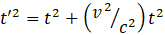
so that
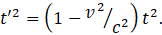
It follows that the relationship between t’ and t is given by
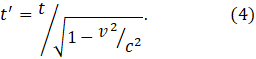
Equation 4 is sometimes written in the form

where the Lorentz factor, γ, is given by
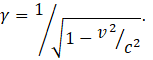
When v is much less than c, which is usually the case, v2/c2 is so small that it is negligible and we don’t notice time dilation. But when v approaches c, t’ is less than t so that time passes more slowly.
Going back to our second picture, when v = c, the value of t’ is infinity so that the observer never sees the burst of light. This is what we would expect because, if S’ appears to be moving away from O’ with the speed of light, so a burst of light can never reach it.
Related posts
26.9 Twin paradox
26.7 Einstein’s special theory of relativity
16.12 Measuring movement
16.9 Does the sun move around the earth?
16.4 Movement
Appendix
I decided to write this appendix after reading the comment by Andrew Morris. It’s not only non-scientists who have problems distinguishing the two frames of reference – I sometimes find it difficult myself.
Reading what I originally wrote, I think I should have explained myself more carefully which is the purpose of this appendix.
Let’s suppose that there is a fully charged capacitor at S and a clock that I will call C; C is used to measure the time taken for the capacitor to discharge half of its charge through a resistor (see post 18.19). The observer O’, who is moving with respect to S as described, has an identical clock called C’ and an identical capacitor that discharges through an identical resistor. C measures time is the frame of reference of S; I’ll call this time t-time. C’ measures time in the frame of reference of O’; I’ll call this time t’-time. Equation 4 shows that t-time and t’-time are not the same.
Let’s suppose that, according to C, the time for discharge will be T. Then according to C’, the time for discharge will still be T because the difference between t-time and t’-time affects both clock and capacitor (both at O’) in exactly the same way. Equation 4 shows that a unit in time (say 1 hour) is longer in t’-time than in t-time.
Observers at O’ and C both observe the capacitors discharging at the same rate but time is passing more slowly at O’ with respect to time at S.
I hope this helps and doesn’t confuse!


Thanks for this David. When I try to explain this to non-scientists, the problem they have is distinguishing the two frames of reference
I wonder if your sentence “The more quickly you move, the slower time passes” should end with “for people outside the moving frame of reference. Inside the frame, time travels at the usual pace”
Andrew Morris
Sent from Outlook for Androidhttps://aka.ms/AAb9ysg ________________________________
LikeLike