Maxwell’s equations describe the behaviour of electric fields and magnetic fields; a more detailed introduction appears in post 25.12.

Equations (1)-(4) (highlighted above) are Maxwell’s equations in vector notation. Here E is an electric field, B is a magnetic field, ∇ is the vector operator del, q is charge, ε0 is the permittivity of free space, ∂/∂t denotes partial differentiation with respect to time, μ0 is the permeability of free space and J is current density.
Equations (1) and (2) are Gauss’ law in differential form; details are given in post 25.12.
Equation (3) is Faraday’s law described as a relationship between fields; details are given in post 25.14.
Equation (4) is the differential form of the Maxwell-Ampère law; details are given in post 26.5.
Mathematical manipulation of these equations (appendix 1) gives the result that

Now I’m going to compare equation 5 with the wave equation (equation 6) from post 19.12.

Here ψ is something that varies in space and time, creating a wave whose speed is v.
Comparison with equation 6 shows that equation 5 represents a wave whose speed in a vacuum is
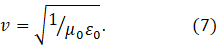
This wave consists of an electric field that varies in time and space. Substituting values for the fundamental constants ε0 and μ0 gives

which is the speed of light in a vacuum.
So, Maxwell considered that a light wave was an oscillating electric field. As more waves with this speed, but with different frequencies (and, hence, wavelengths) were discovered, the idea of electromagnetic waves (post 19.9) developed. The German physicist Heinrich Hertz (1857-1894) provided experimental support for this idea when he produced waves with the same speed as light, but at a lower frequency, from an electrical spark; we now call these waves radio waves.

So why do we think of these electrical waves as “electromagnetic waves”? A charge in an oscillating electric field will oscillate with E, in the same direction. This oscillating charge is an oscillating current that is associated with a magnetic field, B, perpendicular to E (see post 25.10). So we consider that the electromagnetic wave is an electromagnetic wave as described in post 19.9, which is the source of the picture above. Since light can be plane polarised (see posts 20.28 and 20.29) we consider that it is a transverse wave (that is E and B are perpendicular to the direction of propagation), as shown in the picture.
Related posts
26.7 Einstein’s special theory of relativity
26.5 Differential form of the Maxwell-Ampère law
25.14 Electromagnetic induction and fields
25.12 Differential form of Gauss’s law
19.12 The wave equation
19.9 Electromagnetic waves
Appendix 1
Derivation of equation 5
From equation 3

The final step arises because it makes no difference whether we differentiate B with respect to time first, and then space, or the other way round.
If a, b and c are three vectors, there is a relationship between their dot products and cross products that states

(see appendix 2). I am going to make the following substitutions into equation 9

with the result that equation 9 becomes

From equations 8 and 9

From equations 4 and 11

From equations 1 and 12

Now consider a region of space where there is no charge and, therefore, no current so that q = 0 and J = 0. Then equation 13 becomes equation 5.
Appendix 2
To show that equation 9 is true
I would like to write an elegant proof of equation 9 – but I can’t think of one. So I’ve shown it is true by expanding its left and right-hand sides to show that they are identical.
1 Left-hand side
We can write the cross product of b and c as the determinant


The left-hand ide of equation 9 is

I found it easier to calculate the right-hand side of equation 15 by first calculating the cross product of b and c by the cross product of each term in a, as shown below.



Similarly

and

Adding 16a, b and c gives




This result is equation 17.
2 Right-hand side

Then




Similarly



From equations 18 and 19



This result is equation 20.
The right-hand sides of equations 19 and 20 are identical, so that

which is equation 9.
 Thinking about Science with David Hukins