This post is a sequel to post 26.4 so I suggest you read that first.
In post 26.4, I expressed the Maxwell-Ampère law in terms of two definite integrals. In this post I am going to express it in a differential form. This is similar to what I did in post 25.12 where I expressed Gauss’s law in a differential form.
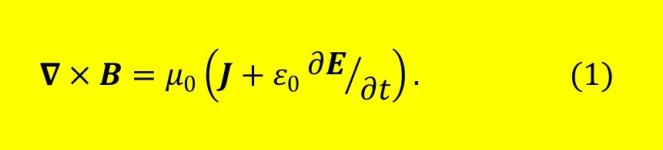
The differential equation of the Maxwell-Ampère law is given by equation 1 above. In this equation, the left-hand side is the cross-product of the operator del with the magnetic field, B. Here μ0 is the permeability of free space, J is the current density (described near the end of post 25.17), ε0 is the permittivity of free space and ∂E/∂t is the derivative of the electric field E with respect to time, t.

Equation 2 is the Maxwell-Ampère law described in post 26.4. The definite integral on the left-hand side is a definite integral over the length, L, of a closed loop formed by a magnetic field line. The definite integral on the right-hand side is over the area, A, enclosed by the loop. Here u is a unit vector perpendicular to an elemental area. It is not a problem that the left-hand integral is a line integral and the right-hand integral is over an area because the function to be integrated, on both sides, is the dot product of vectors and so is a scalar. I is the current flowing through the loop, as in both Ampère’s law and the Maxwell-Ampère law.
We can derive equation 1 from equation 2 by using Stokes’ theorem to express the left-hand integral over area. According to Stokes’ theorem

Since I is the total current flowing through the loop
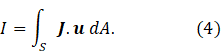
From equations 3 and 4,

Differentiating this result with respect to dA gives equation 1.
Related posts
26.4 Maxwell-Ampère law
26.03 Ampère’s law
25.17 Force on a current
25.14 Electromagnetic induction and fields
25.09 More about fields
17.24 Fields and vectors

