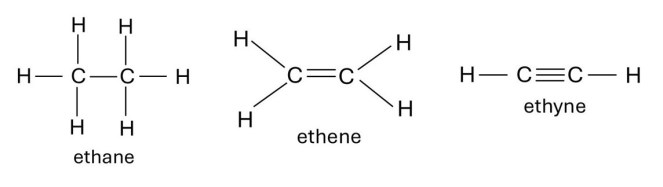
Before you read this, I suggest you read post 25.1.
In post 25.1, I started to describe how the valence bond theory explains how carbon and hydrogen atoms are joined in molecules of ethane, ethene and ethyne (see picture above). My purpose was to introduce the concept of hybrid orbitals.
In this post, I am going to continue with the application of valence bond theory to these molecules: now my purpose is to introduce the concepts of σ (Greek letter sigma) bonds and π (Greek letter pi) bonds.
The main idea of the valence bond theory is that if atomic orbitals associated with different atoms overlap, they can form a covalent bond that joins the two atoms together. The overlapping orbitals must each contain only one electron. The resulting bond contains one electron from each atom; these two shared electrons join the atoms together (see post 16.30 for a simplified explanation). For bond formation to occur the two orbitals must represent the positions of electrons with similar energies. We can represent a bond by a wave function that conventionally represents a region in space in which there is a 95% probability of finding the two electrons (analogous to the atomic orbitals in post 24.12).
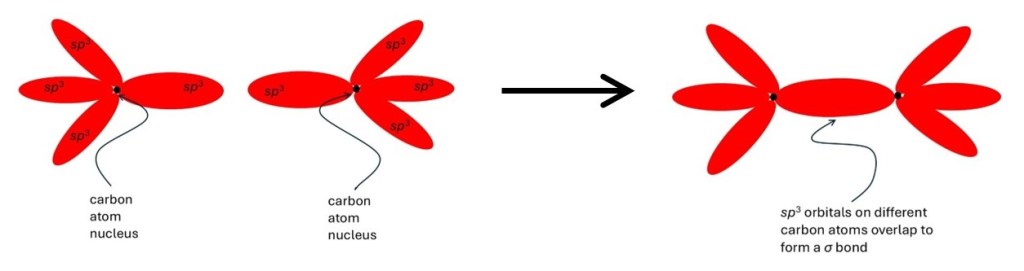
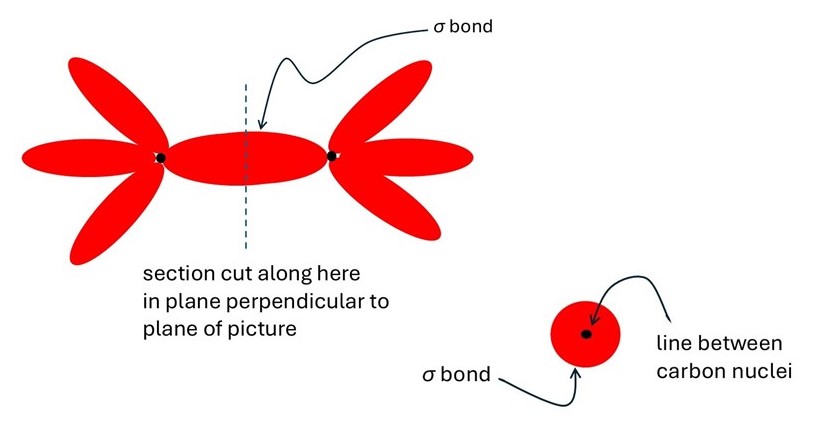
A hydrogen atom has one electron in a 1s orbital. A carbon atom has two electrons in its 1s orbital and four left in its outer shell orbitals available to form bonds (see post 16.30). When a carbon atom forms an ethane molecule, we consider these that these four bonding electrons are each in one of four equivalent sp3 orbitals whose axes point towards the corners of a tetrahedron (see post 25.1). One sp3 orbital from each carbon atom overlaps to form a bond between the two atoms, as shown in the picture above; the bond contains two electrons – one from each carbon atom. Each overlapping sp3 orbital is cylindrically symmetric, so the bond resulting from their overlap also has cylindrical symmetry. A bond with cylindrical symmetry is called a σ bond. To see what cylindrical symmetry looks like, let’s see a section through the bond mid-way between the two carbon atoms – the result is shown in the picture below in which the wave function representing the bond appear to be wrapped evenly around a line drawn between the nuclei of the two carbon atoms.
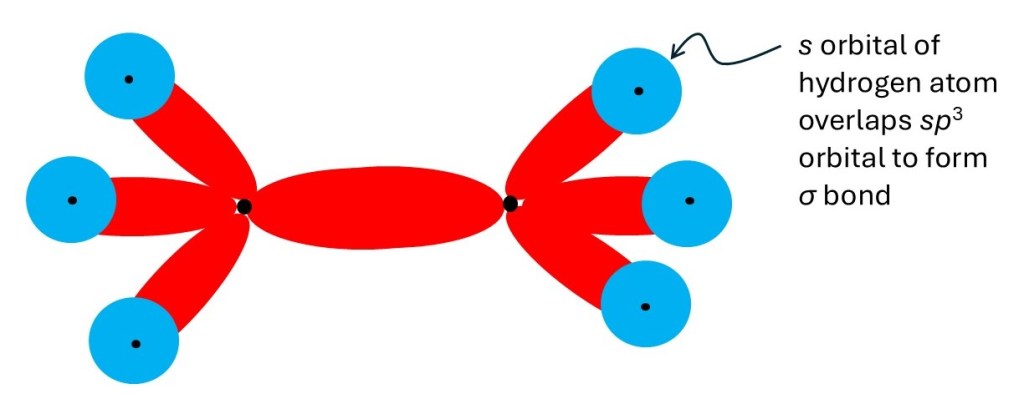
Each carbon atom now has three sp3 orbitals, each containing one electron. Each of these orbitals can overlap with an s orbital on a carbon atom, to form a bond between a carbon atom and a hydrogen atom, as shown in the picture below. Each bond contains two electrons – one from the carbon atom and the other from a hydrogen atom. Since the s orbital has spherical symmetry (it’s like a ball) and the sp3 orbital has cylindrical symmetry, the bond resulting from their overlap has cylindrical symmetry – it’s a σ bond.
When a carbon atom forms an ethene molecule, we consider these that three of its four bonding electrons are in three equivalent sp2 orbitals, that lie in a plane; the remaining bonding electron remains in a pz atomic orbital (see post 25.1). One sp2 orbital from each carbon atom overlaps to form a bond between the two atoms; this bond contains two electrons – one from each carbon atom. So the carbon atoms are joined by a σ bond, as in ethane. The remaining sp2 orbitals (two for each carbon atom) can overlap with the s orbitals of hydrogen atoms to form further σ bonds. Since the sp2 hybrid orbitals lie in a plane the two carbon atoms and the four hydrogen atoms (two for each carbon atom) also lie in a plane.
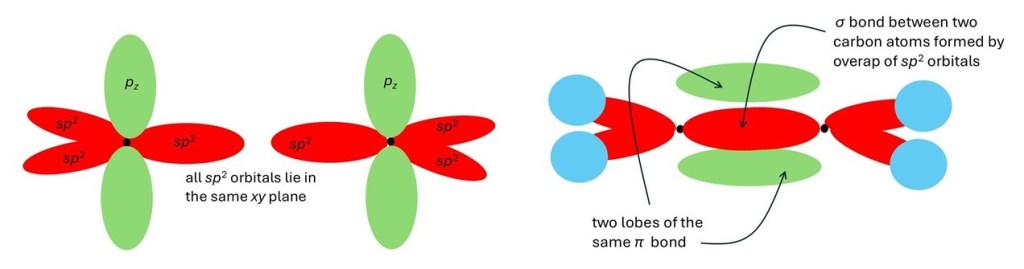
The picture above (left-hand side) shows the two carbon atoms and four hydrogen atoms bonded together – each carbon atom still has a pz atomic orbital containing one electron. These pz orbitals can overlap to form a second bond between the carbon atoms, as shown in the picture above (right-hand side). But this second bond does not have cylindrical symmetry – it consists of two lobes, above and below the plane of the atoms. A section through the molecule, perpendicular to the σ bond between the carbon atoms shows that the second bond is not cylindrically symmetric (picture below); a bond like this is called a π bond. Notice that the orbital describing this bond has two lobes – one above the plane of the atoms (the xy plane) and the other above. But these two lobes are parts of the same π bond.
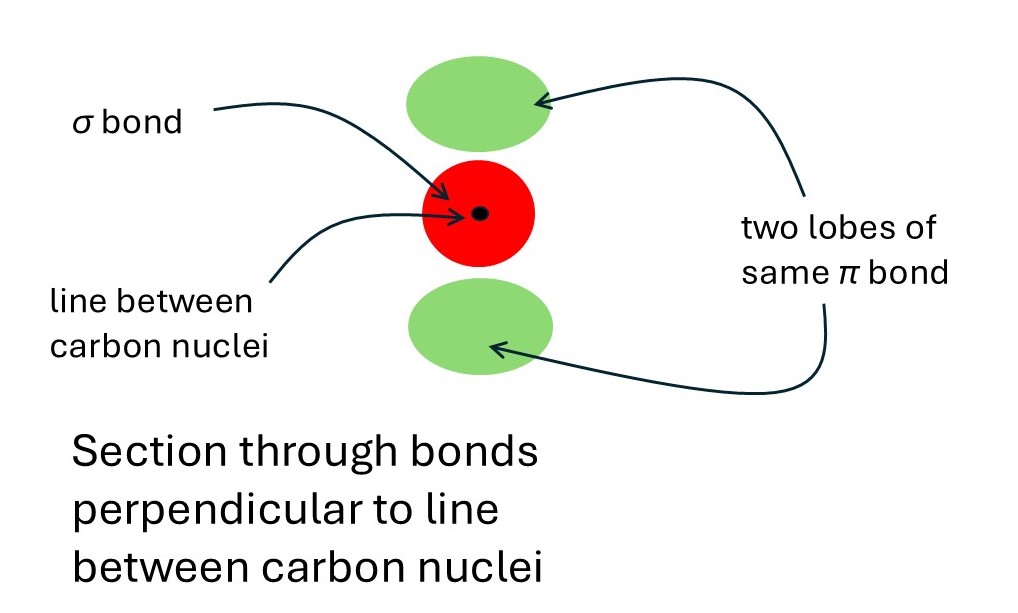
Although the carbon atoms in ethene are held together by a double bond, the two bonds have different symmetries and, as a result, different properties.
We can now understand why we can rotate a molecule about a C-C single bond but not about a C=C double bond (see post 16.47). Rotating about the single bond does not affect it because it is a σ bond with cylindrical symmetry. If we were to rotate about the double bond, the pz atomic orbitals could not overlap and the π bond would be broken. The inability to rotate about C=C double bonds is important for understanding stereoisomerism of carbon compounds (and, therefore, the existence of cis and trans unsaturated fats) and the shapes of protein molecules (post 21.7).
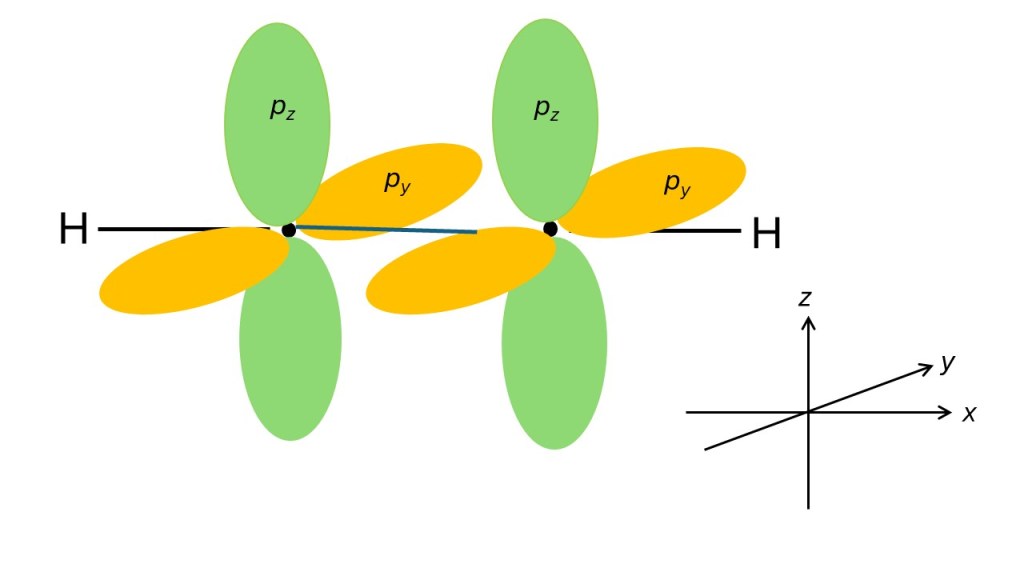
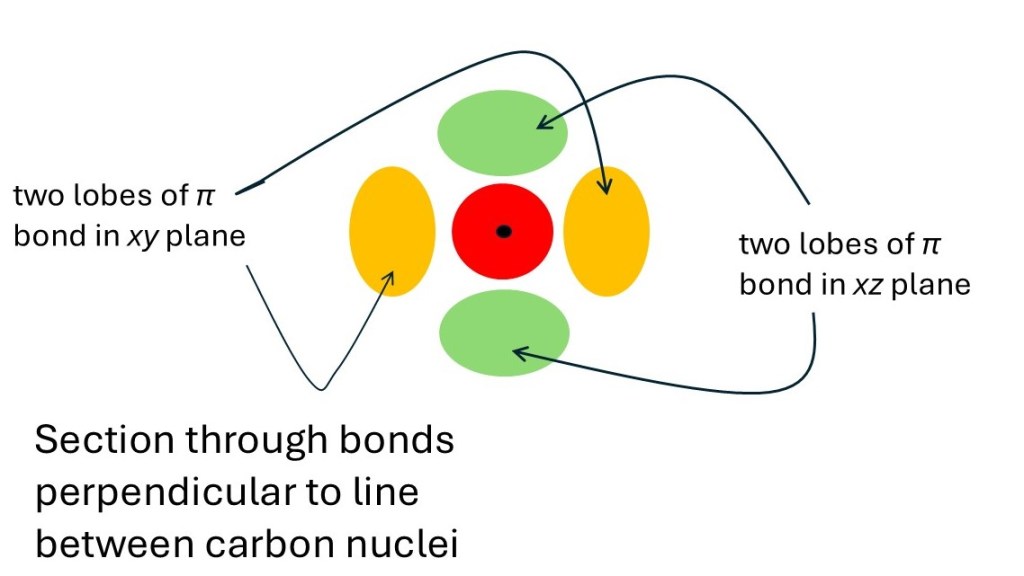
When a carbon atom forms an ethyne molecule, we consider these that two of its four bonding electrons are in two equivalent sp orbitals, that are in a line; the remaining two bonding electrons remain in p atomic orbitals; in post 25.1, I have defined them to be py and py. (To really understand how these orbitals have been defined as py and py, you need to read appendix 6 of post 25.1). One sp orbital from each carbon atom overlaps to form a bond between the two atoms; this bond contains two electrons – one from each carbon atom. So the carbon atoms are joined by a σ bond, as in ethane and ethene. The remaining sp orbitals (one for each carbon atom) can overlap with the s orbitals of hydrogen atoms to form σ bonds as shown in the picture above. The result is two carbon atoms and two hydrogen atoms joined in a line by σ bonds, as shown in the picture ; they are in a line because the sp orbitals form a line. However, the pz and py orbitals remain on each carbon atom, each with one electron. The two pz orbitals can overlap to form a π bond in the xz plane (as in ethene) and the two py orbitals can overlap to form to form a second π bond – this time parallel to the xy plane (parallel to the plane of the picture). So free rotation is not possible about a triple bond between two carbon atoms. A section through the bonds joining the carbon atoms is shown below.
Related posts
25.1 Hybrid orbitals
24.12 Atomic orbitals
16.31 Electrons in molecules
16.30 Molecules
Follow-up posts
 Thinking about Science with David Hukins