So far, in this blog, I have explained that magnetic fields are a result of an electric current (see posts 16.25 and 25.10). But that is not how they were discovered.
The idea of a magnetic field came from the properties of permanent magnets (we usually call them simply magnets). A permanent magnet attracts some things to it because they are made of ferromagnetic materials – iron, cobalt, chromium, rare earths and many of their alloys. Rare earths (for example, neodymium and samarium) are metallic elements that have a high atomic number; their name is unfortunate because many of them aren’t very rare but in some places where they are common, they can be very expensive to extract because they occur in low concentrations. (Ferromagnetism is like paramagnetism but stronger.) The first magnets to be discovered occur naturally and are called lodestones. – they are lumps of the mineral magnetite (iron oxide, Fe2+[Fe3+]2[O2-]4 – this is explained in post 16.39, but it isn’t important if you just want to know about magnets).
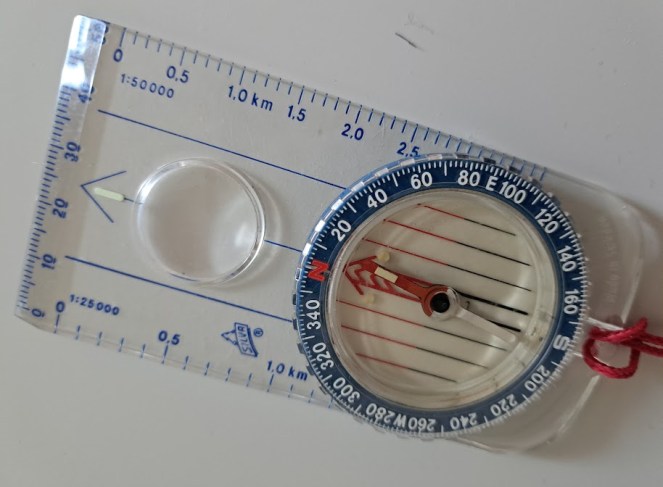
If a lump of magnetite is free to rotate in the horizontal plane, it has an axis that always points towards the north. This is the basis of the magnetic compass, discovered in China over a thousand years ago, that is used for navigation. Normally we use a long thin piece of a magnet, whose axis points north, as a compass needle. But we need to be careful because the magnetic north pole (that the compass points towards) is not in exactly the same direction as the geographic north pole (on the axis of rotation of the earth) – see appendix 1.
We can easily make a magnet from a bar of ferromagnetic material. If we point the bar towards the north and keep hitting it with a hammer, it will become a magnet. And we can destroy our magnet by heating it to a high temperature, called the Curie temperature; the Curie temperature is different for different materials. The Curie temperature is named after the French physicist Pierre Curie (1859-1906) husband of Marie Curie.
These observations can be explained if a magnet is an assembly of small magnetic regions called domains. In most lumps of ferromagnetic material, the domains point in random directions. Hitting the lump shakes the domains which then tend to align so that their north poles point north. Heating the magnet gives the domains kinetic energy (see post 16.35); if this kinetic energy is sufficiently high, it can overcome the attractive force of the earth’s magnetic field. (This is a bit like a rocket overcoming the earth’s gravitational field when its speed and, therefore, its kinetic energy, is sufficiently high – see post 17.27)
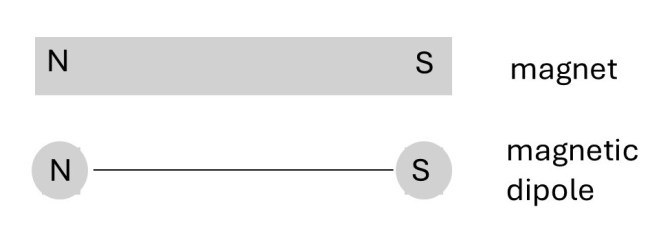
One end of this bar magnet will point north – we call this the north-seeking pole, usually shortened to the north pole; the other end is called the south pole of the magnet. We can think of a magnet as two poles, a north pole and a south pole, whose distance apart is the length of the magnet, as shown in the picture above (N is the north pole and S is the south pole). This arrangement of poles is called a magnetic dipole but he poles don’t exists independently – they’re just a convenient way to help us think about magnets – see appendix 2.
The north pole of a magnet attracts the south pole of another magnet but repels its north pole. We can consider the region in which this force is exerted as the magnetic field. The earth’s magnetic field arises from convection of liquid iron in the earth’s core. The result is that the earth behaves as if it contained a huge magnetic bar, confusingly with its south pole near the earth’s geographic north pole! (The confusion arises from abbreviating “north-seeking pole” to “north pole”). The direction of the earth’s magnetic field, from a north pole to a (magnetic – not geographic) south pole is defined to be the direction of a magnetic field. This means that a compass needle tends to point in the direction of a magnetic field.
In future posts, I want to explore further the relationship between an electric current and a magnetic field. The purpose of this post was to explain how the idea of a magnetic field originated.
Related posts
25.16 Biot-Savart law
25.10 Magnetic fields
16.25 Electric charge
Appendix 1 – Magnetic north
The angular deviation from magnetic north to true north is called the magnetic declination. In Manchester (UK) this is currently 0.12o. But the declination is constantly changing and is updated every 5 years. The change can unpredictable but official British maps (published by the Ordinance Survey) give a simple formula to estimate the change.
Appendix 2 –Dipoles
The north and south poles of a magnetic are hypothetical and do not have independent existence. So the concept of a magnetic dipole is hypothetical.
But, in post 16.45, we saw that electrons are not evenly shared across a water molecule so that it has a positively and negatively charged end – this separation of a positive and negative charge creates an electric dipole. This dipole is not simply hypothetical but is a consequence of a real separation of charges. The concept of an electric dipole is commonly used to help us understand the electrical properties of materials.
 Thinking about Science with David Hukins