A more accurate description of this post would be, seeking a single, simple cause for the combined effect of many factors. But this would be a very cumbersome heading.
Let’s look at an everyday example: a man is depressed after his wife leaves him. His friends believe he is depressed because his wife left him. Perhaps. But perhaps he is happy she has gone but won’t tell other people. He is depressed because a lot of little problems are adding up – one of the children is misbehaving at school, the dog is has bitten the postman, the neighbours are noisy, his back hurts, the electricity bill is unexpectedly high, a tile has blown off the roof………………. The list seems endless to him. Perhaps these problems wouldn’t depress his friends but he is a different person with a different personality.
This type of multifactorial causation doesn’t usually arise in laboratory science, where experiments are performed in carefully controlled conditions (see post 16.3). Or in most theoretical studies that analyse the behaviour of a model system, like an ideal gas or a predator–prey relationship. But it can occur when we apply science to solve problems that can affect us all – so it can occur in engineering and is very common in medicine.
We tend to be unduly influenced by Pasteur’s germ theory of disease. In 1861, the French scientist Louis Pasteur (1822-1895) proposed that diseases were caused by bacterial infection. This leads many people to believe that any disease has a single, identifiable cause.
But most diseases are not that simple. Many cancers are the result of a combination of genetic and environmental factors (for example, diet, smoking and pollution). And psychological factors may affect the response to treatment. (Let’s ignore the question of whether psychological factors could be a physical effect if the mind is the product of the brain.)
An additional comment – ignore it if you want. In medieval and early modern Europe, a belief in witchcraft provided a solution to one of the problems of disease. People were aware that many diseases, like the plague, were infectious – they came to your village when a person visited from a village where infection was a problem. But why did Mrs Smith die of the plague but not Mrs Jones? Because a witch had cast a spell to make Mrs Smith susceptible – the witch was an agent of the Devil! So Mrs Smith was the victim of multifactorial causation – infection and an evil influence. The alternative explanation, that a witch had protected Mrs Jones, appears not to have been considered! We like to think we are more sophisticated nowadays….
Another additional comment – you can ignore this too. As a result of Pasteur’s theory, many people believe that all bacteria are harmful. But we now know that we need a healthy population of bacteria in our gut (the microbiome) for our bodies to function properly; it even appears that the serotonin they produce can affect our mental health. Pasteur proposed protecting people from diseases like diphtheria and brucellosis, by heating milk – a process called pasteurisation. But eating yoghurt or cheese made from unpasteurised milk can have a beneficial effect on our health (provided it is not infected with harmful bacteria), by supplementing the microbiome. These supplements are sometimes called probiotics. Some substances provide food for the bacteria in the microbiome – they are sometimes called prebiotics. Prebiotics occur naturally in food like vegetables, fruit and whole grains (and so in wholemeal bread but not so much in white bread).
Now let’s get back to multifactorial problems and look at back pain as an example. At one time, many people believed that a damaged intervertebral disc was the main cause of low back pain. But it is now recognised that other injuries (like damaged muscles, ligaments and tendons), incurred in day-to-day activities, can result in low back pain. And the pain can be aggravated by psychosocial factors, like anxiety, fear and pessimism (in the sufferer or a friend or relative or work colleague). So, chronic low back pain may flare up in difficult times and diminish when things circumstances are good. Other long-term problems, like irritable bowel syndrome, may behave similarly. As a result, chronic low back pain treatment may target physical injury and/or psychosocial factors.
But how do we explain why chronic back pain suddenly gets better or worse? We tend to look for an explanation whenever a change occurs. It got worse after carrying a heavy bag of shopping. It got better after a cure you read about on the internet (forgetting that the “cure” could be the result of the placebo effect).
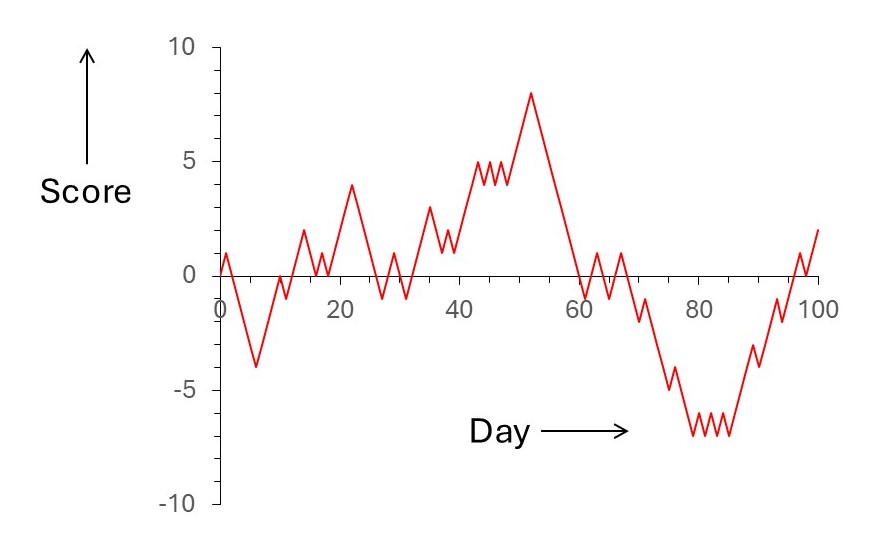
An explanation of random fluctuations like this came not from a medical problem but in engineering – the problem of transmission errors in telephone systems. These errors can have many causes. In 1963 the mathematicians J M Berger and Benoit Mandelbrot (1924-2010, born in Poland who worked in France and the USA) showed that then these errors could cluster to form periods when there was a serious problem – they would subsequently disappear. If there are very many factors influencing change, the changes will appear to be for the better or worse at random, with no simple cause. There is a tendency to believe that, if changes occur at random, their effects will cancel. This belief is not true for random changes in time. Let’s consider changes one day at a time. From one day to the next, things could get randomly better or worse. The probability that the change is for the better or worse is independent of what happened the day before. So a graph showing the distribution of good (positive scores) and bad (negative scores) days might appear like the picture above (see the appendix); a score of 0 represents an average day. If something special happened on day 40, you might suppose that was the reason why things were better for the next 20 days. And you might waste a lot of time trying to identify the cause of the problem between days 70 and 100.
I suggested that the pattern of changes in chronic low back pain was similar to error clustering in telephone systems in a lecture to the Society for Back Pain Research about 30 years ago. Unfortunately, I never found a way in which this hypothesis could be shown to be false, so it is of questionable value (see post 16.3).
I find it interesting that patterns appear in circumstances where we might not expect them – for example, coupling two oscillators can produce unexpectedly complicated patterns (see post 22.18) Perhaps people like finding patterns – if so, we should be careful not to over-interpret them because people seem to like simple explanations as much as they like patterns. A bout of depression or relief from chronic pain could be a result of many different interacting factors and not have a single simple cause.
Related posts
22.25 The Monty Hall Problem
22.18 Coupled oscillators – Lissajou’s figures
19.29 Interpreting quantum mechanics
17.1 It’s obvious
16.46 The placebo effect
Appendix
To produce the picture, I started on day 0, with a score of zero. I tossed a coin to decide what happened on subsequent days. If a got a “head”, I added 1 to the score for the day before. If I got a “tail”, I subtracted 1. Try this for yourself.
 Thinking about Science with David Hukins