I have read several articles about the increasing number of English parents who pay to send their children to private schools and then pay extra for private tuition to gain them a place at Oxford or Cambridge universities (often referred to collectively as Oxbridge); failing that, they hope they will gain a place at one of the other elite (Russell Group) universities (see appendix). This seems to be an obsession in England but not in the other countries of the United Kingdom (Northern Ireland, Scotland and Wales). These parents assume that an education at a leading university (especially Oxbridge) will lead to success in later life. They believe that top jobs are dominated by Oxbridge graduates. This appears to be true for bishops in the Church of England and senior judges. But it doesn’t appear to be true of business leaders. It is often assumed that British politics is dominated by Oxbridge graduates since of the 58 prime ministers, 29 obtained their first degree from Oxford and 10 from Cambridge. But this appears to be changing. Only one leader of a major English political party obtained a first degree at Oxbridge (Ed Davey, Liberal Democrat, Oxford) and one, like several British prime ministers (including Churchill, famous as the British prme minister during the second world war), never attended university (Nigel Farage, Reform UK); the others studied for their first degrees at Cardiff (Rhun ap Iorweth, Plaid Cymru, The Welsh Party), Sussex (Kemi Badenoch, Conservative), Aberystwyth (Zack Polanski, Green), Leeds (Keir Starmer, Labour, the current prime minister – although he has a graduate degree from Oxford) and Edinburgh (John Swinney, Scottish National Party).
This made me wonder where the top British scientists obtained their first degree. The first problem is how to define a “top scientist”. I chose Nobel prize-winners in physics, chemistry and medicine/physiology because, with a very few exceptions, they are or have been very influential and are easy to identify. This definition is not perfect – it tends not to recognise the contribution of many people who have applied science is engineering and clinical medicine and does not include some very influential people – for example, Alan Turing, probably the most influential British scientist of the twentieth century. I have defined “British scientists” as those born in the UK; this excludes many people who we often consider to be British – I was surprised to learn that Maurice Wilkins, who I had always thought was English, was born in New Zealand. Notice that I have included scientists born in all countries of the UK, not just England, because British students often choose to study in a UK country where they were not born – for example, many English students study in Scotland. Also many British scientists have won a Nobel prize for work done in the USA – they are included here because I wanted to know about the institutions that produced the top scientists.
Deciding where people obtained their first degree is not as simple as it may seem because the universities continue to change. Several specialist medical institutions were merged into larger multidisciplinary institutions – for example, St Mary’s Hospital Medical College became part of Imperial College in 1988. Some institutions, like the University of Manchester, evolved from mergers. Others changed their names – Mason College became the University of Birmingham. Many institutions in London belong, or used to belong, to the federal University of London but I have considered them as independent institutions (see appendix). In all cases I have attributed the person’s degree to the current institution so, for example, Owens College in Manchester becomes the University of Manchester. Also I have attributed each winner to the university that awarded the first degree so that Paul Dirac’s prize is attributed to the University of Bristol where he obtained his first undergraduate degree (in electrical engineering) and not to Cambridge where he obtained a second undergraduate degree (in mathematics).
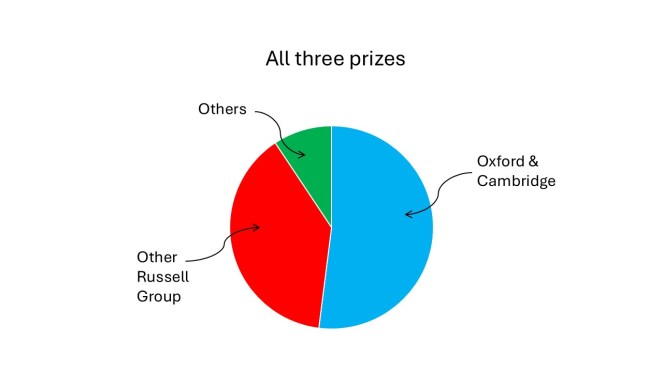
The picture above shows that most of these prize-winners obtained their first degree from a Russell Group University with over half being Oxbridge graduates. But we should be very cautious about using this result to make predictions (see post 16.8). The proportion of UK graduates who attend Oxbridge has been declining for many years and the nature of universities and the society in which they operate is changing also – see the comments about political leaders in the first paragraph. Also the numbers are too small to make quantitative comparisons (see post 16.28).
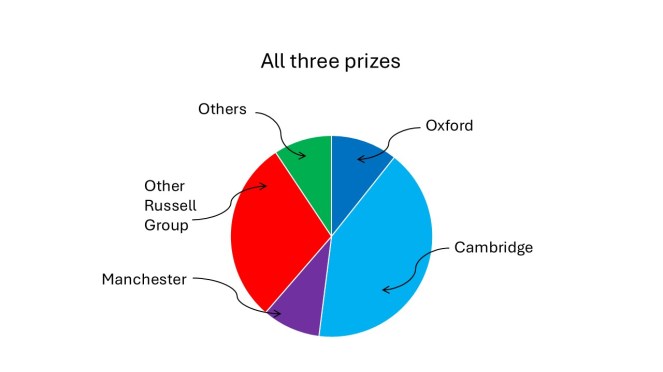
In the picture above, I have separated Oxbridge into the individual universities of Oxford and Cambridge – now the Oxbridge effect appears to be mostly because of the contribution of Cambridge. I have also separated Manchester from the other non-Oxbridge Russel Group institutions – you can see that its contribution is similar to that of Oxford. These results only provide a qualitative impression of what is happening – I haven’t given numbers because they could create a spurious illusion of a quantitative analysis (see previous paragraph).
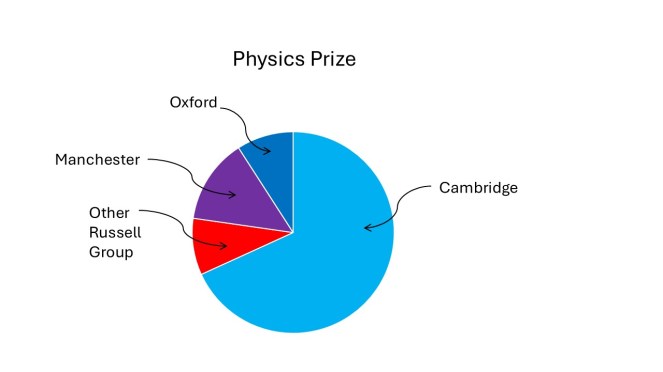
There is also a difference between subjects. The picture above shows that the physics prize-winners are dominated by Cambridge graduates. And Manchester beats Oxford. No physics prizes were awarded to non-Russell Group graduates.
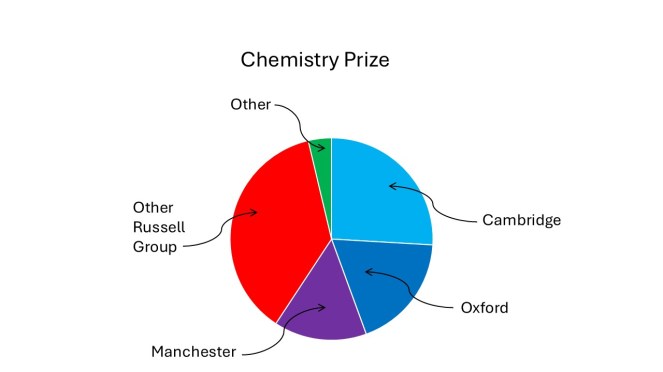
The picture above shows that non-Russel Group graduates have won the Chemistry prize but the Russell Group still dominates with Cambridge, Oxford and Manchester (in that order) responsible for a large share of the winning graduates.
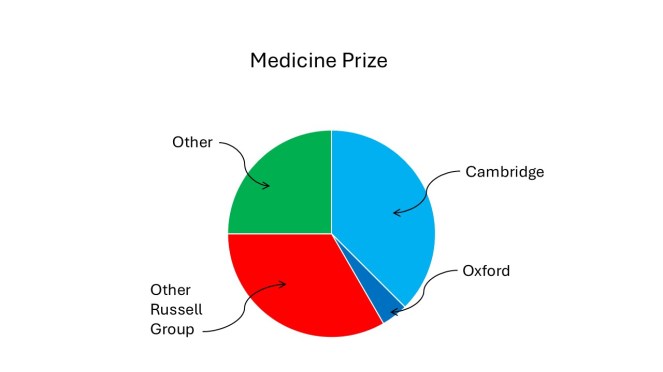
The medicine prize has been awarded to roughly equal numbers of Cambridge, other Russell Group (including Oxford) and non-Russell Group institutions, as shown in the picture above. Neither Oxford nor Manchester especially stand out here.
What will happen in the future – a changing university system makes it very difficult to predict. Michael Houghton was awarded the prize for medicine/physiology in 2020. He obtained his first degree from the University of East Anglia that was founded 68 years after the first Nobel prize was awarded. Finally, if you’re a student who didn’t go to Oxbridge or any other Russell Group university, don’t despair – you are in the company of many successful scientists, including some Nobel prize-winners.
Related posts
17.46 Peeing contests
17.33 Lord Kelvin and flying machines
17.25 Diminishing deception
16.15 Science education
16.11 Giving a scientist a job
Appendix Russell Group Universities
Those that have produced the Nobel prize-winners considered in this post are given in italics.
Birmingham, Bristol, Cambridge, Cardiff, Durham, Edinburgh, Exeter, Glasgow, Imperial College*, King’s College London*, Leeds, Liverpool, London School of Economics*, Manchester, Newcastle, Nottingham, Oxford, Queen Mary*, Queen’s Belfast, Sheffield, Southampton, University College London*, Warwick, York.
*Current or former members of the federal University of London – are considered independent institutions here.
 Thinking about Science with David Hukins